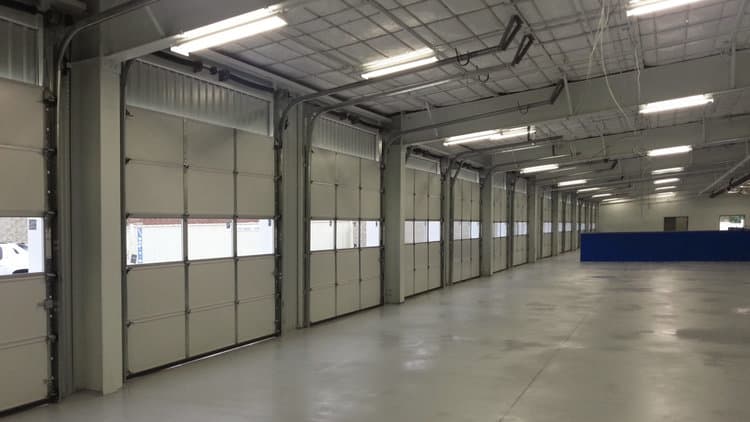
Commercial Spring Repair
Counterbalance and spring work on commercial doors, where the assembly is matched to the specific curtain or panel build rather than pulled off a shelf.
What Is Commercial Spring Repair?
On a commercial coiling door the counterbalance is not a stock item, and that is the first thing worth understanding about commercial spring work. Rolling service doors in the Overhead Door line are computer-designed to the specification of the individual opening, and the counterbalance system is then computer-matched to that door. Weight is the reason. Curtains are fabricated in galvanized steel, stainless steel or aluminum across a range of gauges and slat profiles, from a lightweight 26-gauge Coil-Away curtain up to a 14-gauge C-600 slat on the 610 Series, and the line covers openings as large as 1500 square feet. Two curtains filling the same hole can be very different masses, and a counterbalance sized for one of them is simply wrong for the other.
Duty class matters as much as size. The rolling service range is built in light-duty, medium-duty and heavy-duty configurations, and the counterbalance on any given door was matched to the class that door was specified for, not to how the opening is being used now. When a facility's throughput has grown since the door went in, the counterbalance is carrying assumptions that no longer hold. On openings running an RMX operator there is a way to settle that rather than estimate it: the RMX carries a built-in cycle counter displaying the total cycles logged over the operator's lifetime, which converts an argument about how hard a door works into a number.
Roll-up doors of this type may use a counterbalance spring system or an electric motor to assist with lifting and lowering, and many of them use torsion springs for that job. When the spring side of the assembly begins to give up, the door signals it well before it stops: it becomes difficult to open or close, its travel across the opening turns uneven, it makes loud or creaking noises while running, and it feels unusually heavy when lifted by hand. Those symptoms should not be worked around. A spring holding a commercial curtain's weight is under high tension and can release suddenly, which is why replacing the springs on a roll-up door is specialist work rather than in-house maintenance.
Commercial sectional doors are a different assembly with the same underlying question. Here the weight comes out of how the door was built: the panels come in 16, 20 or 24-gauge steel, steel strutting is an option where a door has to take a high windload, and the door is configured for either electric or chain hoist operation. Each of those decisions moves what the door weighs, and a counterbalance only balances the particular door it was fitted to. So the series, the panel gauge and the presence or absence of strutting get established first, because between them those three facts define the load.
A meaningful part of the commercial range carries no springs at all, which makes establishing whether the door even has springs the honest first move on a commercial spring call. The High Cycle Springless Rolling Service Door exists for the environments where conventional springs give the most trouble — warehouses, distribution centers, manufacturing plants, automotive service bays — and it is rated for tens of thousands of cycles, using an electric motor with a gear-driven or direct-drive mechanism in place of a spring counterbalance. RapidFlex high performance doors are springless as well, opening fully in four seconds or less depending on height. On a door built that way there is no stored tension to release and nothing to rewind, so a fault that presents like a spring problem is sitting in the drive or the curtain instead, and calling it a spring is how the wrong part gets ordered.
Commercial Spring Repair — Services & Options
- ✓Computer-matched counterbalance systems on rolling service doors
- ✓Counterbalance identified against curtain material, gauge and slat profile
- ✓Light-duty, medium-duty and heavy-duty rolling door configurations
- ✓Actual cycle count read from the RMX operator's built-in counter
- ✓Torsion spring and counterbalance spring systems on roll-up doors
- ✓Commercial sectional doors in 16, 20 and 24-gauge steel
- ✓Electric and chain hoist sectional configurations
- ✓Steel strutting on high-windload doors accounted for in the load
- ✓Springless High Cycle Rolling Service Door as an alternative to spring counterbalance
- ✓RapidFlex high performance doors, springless by design
Common Questions About Commercial Spring Repair
Do commercial roll-up doors have springs?
Many of them do. A roll-up door may use a counterbalance spring system or an electric motor to assist with lifting and lowering, and torsion springs are common in that role. Part of the commercial range is deliberately springless, though — the High Cycle Springless Rolling Service Door and the RapidFlex high performance doors both do without a spring counterbalance. Establishing which of those a door is comes before anything else, because it decides whether there is a spring in the picture at all.
Why does a commercial counterbalance have to be matched to the specific door?
Because the doors themselves vary so widely in weight. Rolling service curtains are fabricated in galvanized steel, stainless steel or aluminum in a range of gauges and slat profiles, from a lightweight 26-gauge Coil-Away curtain to a 14-gauge C-600 slat, and the line covers openings up to 1500 square feet. Each door is computer-designed to its specification and the counterbalance system is computer-matched to it, so the correct assembly follows from the door's specification rather than from the size of the hole in the wall.
How can I tell how hard a commercial door is actually being worked?
On an opening fitted with an RMX operator, read it off the operator. The RMX has a built-in cycle counter that displays the total cycles logged over its lifetime. That figure matters because rolling service doors are built in light-duty, medium-duty and heavy-duty configurations, and a door that has quietly moved into a heavier pattern of use than it was specified for is working its counterbalance beyond the class it was matched to.
What are the warning signs that a commercial door's spring system is failing?
Four show up most often: the door becomes difficult to open or close, its travel across the opening goes uneven, it makes loud or creaking noises while running, and it feels unusually heavy when lifted by hand. None of these are worth working around. A spring carrying a commercial curtain's weight is under high tension and can release without warning, so this is work for someone equipped for it rather than a maintenance task to absorb in-house.
Does replacing one panel change anything about a sectional door's counterbalance?
It can, because the counterbalance is balancing that specific door. Panel gauge on these doors is 16, 20 or 24, and steel strutting is an option on any door that has to take a high windload, so two sections that look interchangeable need not weigh the same. Anything that alters what the door weighs alters what the counterbalance is holding, which is why the series, the gauge and the presence of strutting are confirmed before work starts.
Need help with Commercial Spring Repair? Call us today.
(360) 734-5960Request a Commercial Spring Repair Estimate
Fill out the form below and we'll get back to you within one business day.