Commercial Emergency Service
When a commercial opening stops moving it takes something with it: a dock bay out of use, a counter left open, work banked up behind a door that will not travel. Emergency work here starts from what the stopped opening was doing.
What Is Commercial Emergency Service?
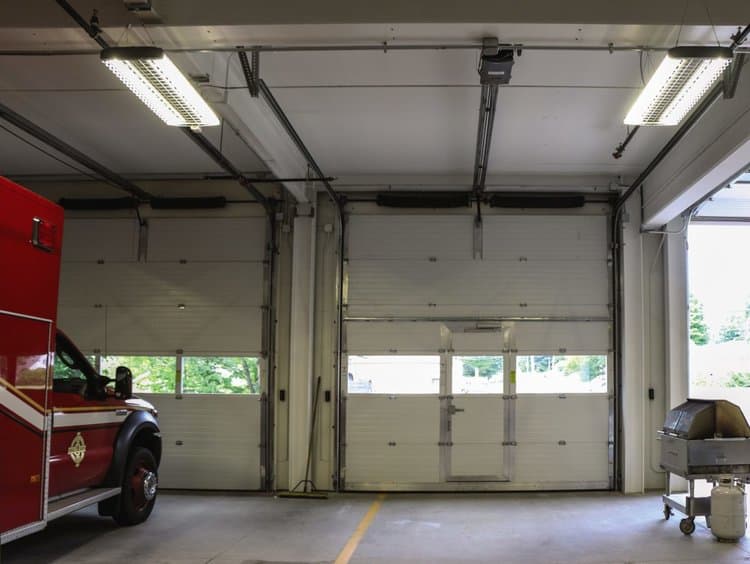
What makes a commercial emergency different from a residential one is usually not the repair. It is what was going on through the opening when it stopped. A house door has a car and a garage behind it. A commercial opening is a working part of the building: the route goods travel in and out, the barrier that closes a counter when the public side of it is unattended, the bay a vehicle has to leave from. Aluminum glass sectional doors are specified for service stations, fire stations, professional facilities and retail spaces, and every one of those is a building where an opening that will not travel has an immediate cost attached. Thermacore commercial doors go into buildings that require the highest levels of thermal efficiency and the lowest air infiltration, so an insulated opening stuck open is losing the condition of the space as well as the use of the door.
Some commercial openings exist in order to be closed. Rolling shutters are light door systems that provide security for high pedestrian traffic areas such as retail stores, pharmacies and hospitals. Rolling counter doors cover small openings where security is important, at concession areas, cafeterias, pharmacies, parts-storage areas and ticket windows. Security grilles are fitted to restrict public access, with side-folding models used where headroom is limited or the grille has to follow a radius. On any of those the door is the security rather than an addition to it, so a curtain or a grille that will not come down leaves an open building, not an inconvenience.
Other openings exist to move traffic, and the equipment specified for them records how much. The RapidFlex high-speed series is engineered to allow maximum productivity, with fast-acting curtains that open fully in four seconds or less depending on height and a springless, high cycle design intended to minimise downtime. A door built to that standard was chosen because the flow through the opening does not pause, and when it halts the flow banks up behind it. That same series is built with resistance to damage from accidental collisions, which is a fair statement of what happens at openings like these: contact from a vehicle or a load is anticipated rather than unusual.
At a loading dock the door is only one of three things that can put a bay out of use. Dock levelers differ in how they are worked, and the difference shows up in the symptom: hydraulic levelers are push-button activated with fully powered raise and lip extension functions, air-powered levelers raise and lower the deck with an air bag or bellows system, and mechanical levelers use a pull chain to raise the deck. Vehicle restraints are the third item, securing a trailer to the dock and providing better communication between the truck driver and the dock attendant, which is how they help prevent accidents. A bay that has gone down can be the door, the leveler or the restraint, and separating the three is where the work begins.
A fair share of commercial calls finish at the operator or one of its modules rather than at the door. The commercial range runs from the light duty CDX used on counter and counter fire door applications through the RMX and the RSX to the heavy duty RHX, with continuous duty motors offered in 1/2, 3/4 and 1 HP and in single-phase or three-phase, so an opening that has gone dead is not always a mechanical problem. The RMX carries a built-in cycle counter showing total cycles logged over the operator's lifetime, which is the nearest thing to a usage record most openings have. Reflective photo eyes for industrial openings use interference reduction or red light technology for a reason, because ambient lighting, other infrared sensors and reflective surfaces around these openings all work against a beam. And the electric sensing edge earns its own mention: two flexible conductive contact elements separated by perforated foam that stop or reverse the door when the foam compresses, and the same edge forms the weather-tight seal that conforms to the floor, so physical damage there takes out the entrapment protection and the seal together. A fire-rated closure is the inverse case, designed to come down automatically on a fire or an alarmed event, so the emergency it produces is a closed opening rather than an open one, and that opening stays out of use until the door has been reset.
Commercial Emergency Service — Services & Options
- ✓Rolling shutter and security grille faults that leave an opening unsecured
- ✓Counter doors stuck open at concession, cafeteria, pharmacy and ticket-window openings
- ✓High-speed RapidFlex curtains damaged by accidental collision
- ✓Loading dock bays out of use, whether the door, the leveler or the restraint
- ✓Hydraulic, air-powered and mechanical dock levelers
- ✓Vehicle restraints holding a trailer to the dock
- ✓CDX, RMX, RSX and RHX operator faults, single-phase and three-phase
- ✓Photo-eye interference from ambient lighting, infrared sources and reflective surfaces
- ✓Electric sensing edge damage, which removes entrapment protection and the floor seal together
- ✓Fire-rated closures that have come down on an alarmed event and are waiting to be reset
Need Commercial Emergency Service?
Contact us today.
Common Questions About Commercial Emergency Service
Why does a stuck commercial door matter more than a stuck door on a house?
Because of what the opening is doing. On a commercial building the door is often the security itself: rolling shutters are used for high pedestrian traffic areas such as retail stores, pharmacies and hospitals, counter doors cover small openings where security is important, and security grilles are there to restrict public access. Elsewhere the opening is the route work travels through, whether that is a dock bay or a bay at a service station or a fire station. A door that will not travel stops the function the opening was built for, and that is the difference.
A dock bay has stopped working but the door looks undamaged. What else could it be?
Two other things at least. Dock levelers are activated differently by type, so the symptom differs with them: hydraulic levelers are push-button activated with fully powered raise and lip extension functions, air-powered levelers raise and lower the deck with an air bag or bellows system, and mechanical levelers use a pull chain. Vehicle restraints are the other, securing a trailer to the dock and providing better communication between the truck driver and the dock attendant. A bay out of use can be any of the three, and which one it is changes the work completely.
Why would a commercial door reverse or refuse to close when nothing is in its path?
An industrial opening is a hard environment for a beam. Reflective photo eyes made for these applications use interference reduction or red light technology to cut interference from surrounding lighting and from the infrared sensors often found around industrial openings, with further engineering to reduce interference from reflective surfaces. The other device in the closing path is the electric sensing edge, which stops or reverses the door when the perforated foam inside it compresses. Because that edge also forms the weather-tight seal against the floor, damage to it can read as both a safety fault and a seal problem.
What can the operator itself tell you about why a door failed?
More than people expect. The commercial operators run from the light duty CDX, used on counter and counter fire door applications, through the RMX and RSX to the heavy duty RHX, with continuous duty motors in 1/2, 3/4 and 1 HP and single-phase or three-phase options, so identifying the unit on the opening narrows the possibilities before anything is dismantled. The RMX also has a built-in cycle counter that displays the total cycles logged over the operator's lifetime, which is the nearest thing to a usage record most openings have and says whether the door has been working at the rate it was specified for.
Need help with Commercial Emergency Service? Call us today.
(360) 734-5960