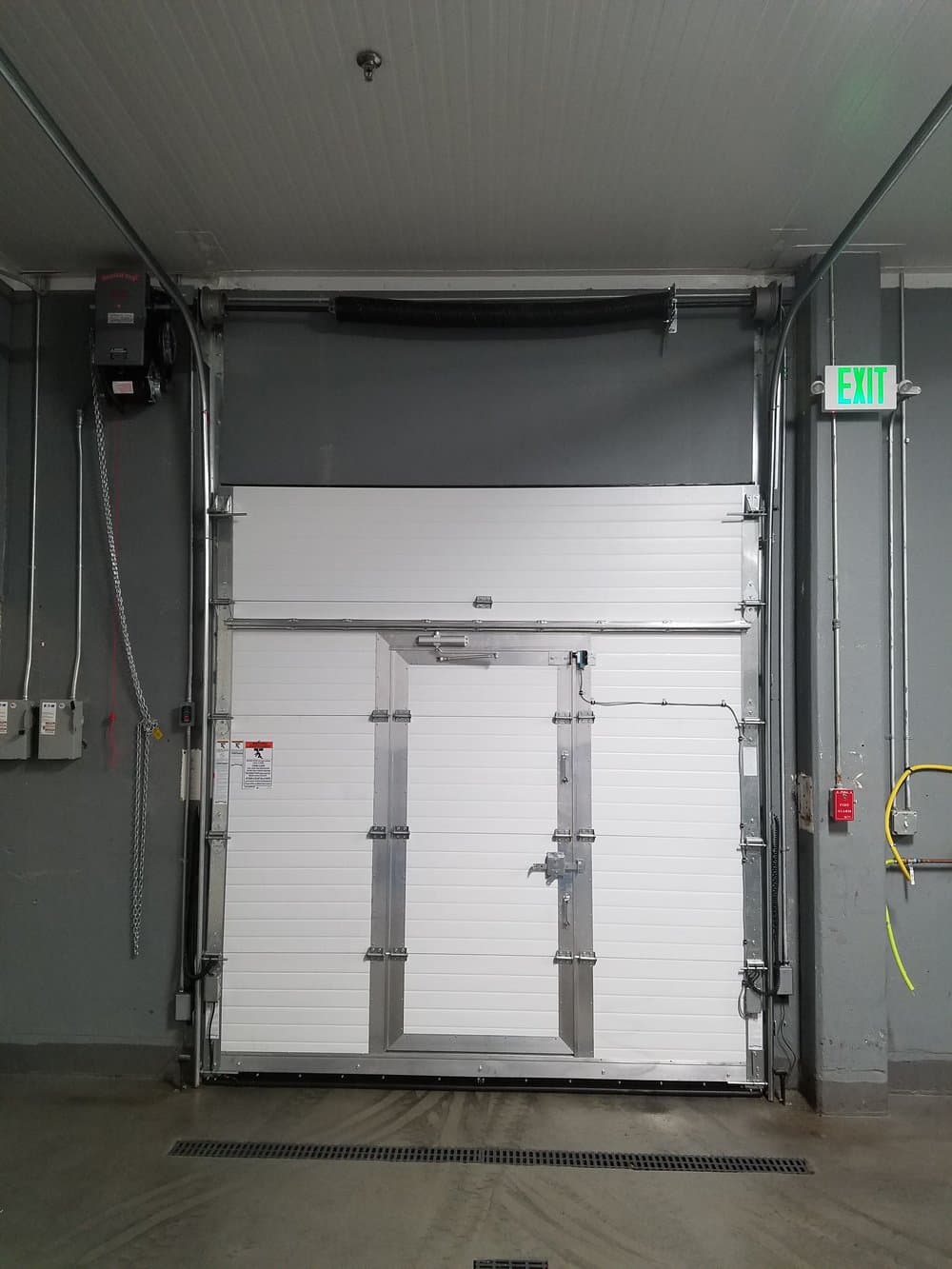
Commercial Replacement Track
Track and guide work on commercial doors — the heavy-duty galvanized track and hardware under sectional and insulated panel doors, and the vertical guides that upward-coiling curtains, shutters and grilles run in instead.
What Is Commercial Replacement Track?
Commercial doors do not all hang the same way, and that is the first thing that matters when the part carrying a door has to be replaced. A sectional door travels on track. An upward-coiling door has no sectional track at all — its curtain rolls up at the head of the opening and is held at its edges by guides. Both get described as track work when something stops moving properly, and they are not the same work, so establishing which system is in the opening comes first.
On the Overhead Door commercial sectional line, track is a specified variable rather than a generic part. The sectional steel series is offered across a selection of panel profiles, gauges, track styles and hardware options, which means the track under any given door was chosen with that door rather than added to it. Heavy-duty track and hardware in the series are fabricated of high-quality galvanized steel and engineered for precise, trouble-free performance; the two are named together in that specification because neither meets it alone. Aluminum sectional doors follow the same logic from the other direction — track style is specified there alongside stile width, glazing material and finish. So a replacement run has to reproduce the original specification, not approximate it.
Insulated panel doors carry a consequence a plain steel door does not. Thermacore® commercial doors are built for buildings that need the highest levels of thermal efficiency and low air infiltration, using a dual thermal break and joint seal between the internal and external skins, and the series runs on specially designed track with heavy-duty fixtures that ensure a tight and reliable fit. That fit is the whole point of the door. When track on one of these is pulled out of line, or its fixtures are worn, what degrades is not only how smoothly the door travels but how closely it shuts — and shutting closely is the reason the door was specified in the first place.
Upward-coiling doors answer the same opening a different way. Rolling service doors suit situations where sideroom and headroom are at a premium: the curtain is fabricated of interlocking steel, stainless steel or aluminum slats and coils at the head of the opening rather than being carried back on track, so what holds it is a pair of vertical guides at the sides. Rolling shutters and upward-coiling security grilles work on that same principle. Counter doors go further still: on an integral frame and sill unit the surround arrives factory-assembled as a complete welded unit with 16-gauge jambs and header, a 14-gauge sill, hood and fascia, so the guiding is part of the door delivered rather than components fitted to the building. Side-folding grilles are the outlier: they stack to the side instead of coiling, which is what lets them serve an opening where headroom is limited or where the grille has to follow a radius.
Two things follow from which system a door uses. The first is the operator. The RHX, RSX and RMX commercial operators are each offered with a wide variety of mounting options for both sectional and rolling doors, and the CDX is the unit used on counter and counter fire door applications — so how a door is guided is bound up with how its operator sits on it, and track or guide work is worth checking against that mounting rather than treating the two as unrelated. The second is fire-rated closures, where guide position carries design intent: counter fire doors are designed to expand upward in a fire, and installing the guides flush with the sill is what allows that to happen. Everything else starts from the same four answers — the door series, sectional or coiling, insulated or not, and which track style or guide the door was originally built with.
Commercial Replacement Track — Services & Options
- ✓Track style matched to the commercial sectional door already in the opening
- ✓Heavy-duty galvanized steel track and hardware on sectional steel doors
- ✓Specially designed track and heavy-duty fixtures on Thermacore® insulated doors
- ✓Track style matched alongside stile width and glazing on aluminum sectional doors
- ✓Vertical guides for upward-coiling rolling service doors
- ✓Guides for rolling shutters and upward-coiling security grilles
- ✓Counter door guiding, including factory-assembled integral frame and sill units
- ✓Side-folding grille runs for openings with limited headroom or a radius
- ✓Operator mounting checked against sectional or rolling configuration
- ✓Counter fire door guides set flush with the sill
Common Questions About Commercial Replacement Track
Can the track be replaced on a commercial sectional door without replacing the door?
Usually, provided the original specification can be identified. Track style is one of the variables the Overhead Door commercial sectional series is specified across, alongside panel profile, gauge and hardware options, so a run of track belongs to a particular door rather than fitting any door. Heavy-duty track and hardware in the series are fabricated of high-quality galvanized steel and engineered together, which is why both get looked at rather than only the length that is visibly damaged.
Do rolling steel doors and security grilles run on track?
Not in the sectional sense. A rolling service door coils at the head of the opening, which is what suits it to a building short on sideroom and headroom, and its interlocking steel, stainless steel or aluminum curtain is held by vertical guides at the sides instead of travelling back on overhead track. Rolling shutters and upward-coiling grilles are the same arrangement. Side-folding grilles are different again, stacking to the side, which is what suits them to openings with limited headroom or a radius to follow.
Why does distorted track matter more on an insulated commercial door?
Because the seal depends on it. Thermacore® commercial doors are specified for high thermal efficiency and low air infiltration, with a dual thermal break and joint seal between the internal and external skins, and the series uses specially designed track and heavy-duty fixtures to hold a tight and reliable fit. Once that track is out of line, the door can still open and close while no longer shutting as tightly as the specification assumes, so the loss shows up as air infiltration before it shows up as a mechanical fault.
What needs to be identified before track or guides can be ordered?
Four things: the door series, whether the door is sectional or upward-coiling, whether it is insulated or non-insulated, and which track style or guide it was originally built with. The operator matters too, since the RHX, RSX and RMX units offer mounting options for both sectional and rolling doors and the CDX is used on counter and counter fire door applications — the mounting on a specific door is tied to how that door is guided.
Need help with Commercial Replacement Track? Call us today.
(360) 734-5960Request a Commercial Replacement Track Estimate
Fill out the form below and we'll get back to you within one business day.