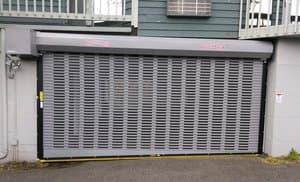
Commercial Garage Door Repair
Repair and service for commercial door systems: upward-coiling steel curtains, counter doors, security grilles, high-speed curtains, sectional steel and insulated panel doors, aluminum glass, and fire-rated closures — along with the operators and safety accessories that run them.
What Is Commercial Garage Door Repair?
A commercial opening is rarely the same machine as a residential one. The commercial door systems serviced, installed, and repaired here run from upward-coiling steel curtains and rolling shutters through counter doors, security grilles, high-speed curtains, sectional steel, insulated Thermacore units, aluminum glass fronts, and fire-rated closures. Each carries its own hardware, its own operator, and its own service points, which is why commercial work is scoped apart from residential work.
Coiling systems account for much of it. Rolling service doors are fabricated of interlocking steel, stainless steel, or aluminum curtains in a range of slat profiles, and they suit openings where sideroom and headroom are at a premium because the curtain coils upward at the head of the opening. Rolling counter doors cover smaller openings and come in three basic types — metal curtain, wood curtain, and integral frame and sill — the sort fitted at concession areas, cafeterias, pharmacies, parts-storage areas, and ticket windows. Rolling shutters and security grilles work on the same coiling principle, so they share most of the same service points.
Sectional systems behave differently. Commercial sectional steel doors come insulated or non-insulated across a range of panel profiles, gauges, track styles, and hardware, and are configured for either electric or chain hoist operation — which of the two is fitted changes what can be inspected and what can be adjusted. Aluminum sectional doors trade some of that construction for visual access and light transmission. High-speed curtains are different again: the RapidFlex line uses a springless, high-cycle design and a direct gear drive that removes the wear associated with conventional chain and sprocket arrangements, and it is built to resist damage from accidental collisions, so its service points are not the same as a spring-and-cable door's.
Behind most commercial doors sits an operator and a set of accessory modules, and a fair share of reported faults turn out to be there rather than in the door itself. The commercial operator range covers the CDX, RHX, RSX, and RMX units. Around them sit photo eyes and reflective photo eyes, electric safety edges, timer-to-close and auxiliary output modules, interface modules, and radio transmitters. Photo-eye sensors are what reverse a closing door when something crosses its path, and the emergency release is what allows the door to be worked by hand during a power outage or a malfunction — both are worth testing rather than assuming.
Fire-rated closures follow their own logic. They are designed to close automatically in the event of a fire or an alarmed event, with fusible links mounted on both sides of the wall that separate to release the door, and the Fire Sentinel time-delay release device controls how that closure happens. The Fire Minuteman chain reset hoist exists so that resetting a dropped door does not require releasing the door's spring tension and can be done by one person from the floor. Scheduled testing of fire doors is handled as its own service rather than folded into general repair. For everything else, maintenance checks on a commercial door are generally due at least twice a year, with the interval shortening for heavier use or harder environmental conditions, the point being to catch a developing fault before it becomes unplanned downtime.
Commercial Garage Door Repair — Services & Options
- ✓Rolling steel service doors in interlocking steel, stainless steel or aluminum curtains
- ✓Rolling counter doors — metal curtain, wood curtain, integral frame and sill
- ✓Rolling shutters and security grilles
- ✓Commercial sectional steel doors, insulated and non-insulated
- ✓Thermacore insulated panel doors and aluminum glass sectional doors
- ✓High-speed RapidFlex curtains with springless direct gear drive
- ✓Fire-rated closures with fusible links and Fire Sentinel time-delay release
- ✓CDX, RHX, RSX and RMX commercial operators
- ✓Photo eyes, electric safety edges, timer-to-close and interface modules
Common Questions About Commercial Garage Door Repair
How often should a commercial garage door be checked?
Maintenance checks on a commercial garage door should typically occur at least twice a year. The frequency may vary based on how often the door is used and on local environmental conditions. Regular inspections help identify and address potential issues before they become significant problems, which is what keeps a door operating smoothly and minimises unplanned downtime.
Which safety devices should be tested on a commercial door?
Most commercial doors carry photo-eye sensors that detect an obstruction in the door's path and reverse the door before it makes contact. Alongside those, the emergency release allows the door to be operated by hand during a power outage or a malfunction, and a battery backup system keeps a powered door operable when the supply fails. Electric safety edges are also fitted on many commercial installations. All of these are devices that need checking rather than assuming.
Is a fire-rated door serviced differently from a standard commercial door?
It is, in one important respect. A fire-rated door is designed to close automatically in the event of a fire or an alarmed event, using fusible links mounted on both sides of the wall that separate to release the curtain. The Fire Sentinel time-delay release device controls that closure, and a Fire Minuteman chain reset hoist allows a dropped door to be reset by one person from the floor without releasing the door's spring tension. Scheduled fire door testing is handled as its own service rather than as part of general repair.
Are high-speed doors serviced the same way as spring-loaded doors?
They are not. The RapidFlex high-speed line uses a springless, high-cycle design with a direct gear drive, which removes the wear associated with conventional chain and sprocket systems. Because there is no spring assembly, attention falls on the drive and the curtain instead, and the curtains are built to resist damage from accidental collisions.
Need help with Commercial Garage Door Repair? Call us today.
(360) 734-5960Request a Commercial Garage Door Repair Estimate
Fill out the form below and we'll get back to you within one business day.